

[rs_section_text_block style=”style2″ heading=”New Ceramics 4/2019 – Content”][/rs_section_text_block]
NEWS
INTERVIEW
Si-Sook Kang Korea / Germany
PROFILES
John Dermer – Australia
Enric Mestre – Spain
Gilles / Wiemann – France
Hana Novotná – Czech Republic
Arina Ailincai – Romania
FORUM
Our World – Gustav Weiß – Art Philosophy
EXHIBITIONS / EVENTS
NCECA – Minneapolis – USA
3 Families of Potters – Onta – Japan
Interreg Europe – Limoges – France
Exponate – Höhr-Grenzhausen – Germany
Ceramic Art – London – UK
Fes_Tea_Val – Wiesbaden – Germany
Sculptural Biennial – Datong – China
Delicate Wings – Fat Bluebottles – Frechen – Germany
A Matter of Form – Hohenberg / Selb – Germany
CERAMICS AND TRAVEL
Ceramics in the Sultanate – Oman
ARTIST JOURNAL
Rokubey Kiyomizu – Japan and Sylvie Enjalbert -France – Ting-Ju Shao
IN STUDIO
Ruth Ju-shih Li – Evelyne Schoenmann – Interview / Developing Skills
DATES / Exhibitions / Galleries / Museums
COURSES / SEMINARS / MARKETS
ADVERTISEMENTS
PREVIEW
[rs_section_title style=”style3″ title=”New Ceramics 4/2019″ class=”p-b-30″]Click on the symbols for further details.[/rs_section_title]
INTERVIEW
Si-Sook Kang – KR/DE
PROFILES
John Dermer – AU, Enric Mestre -ES, Gilles / Wiemann – FR, Hana Novotná – CZ, Arina Ailincai – RO
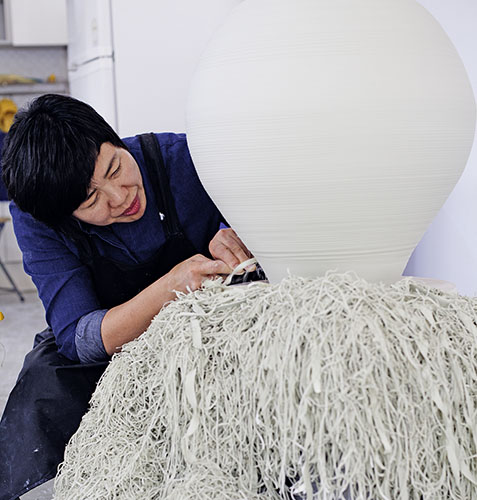
Si-Sook Kang
EXHIBITIONS
NCECA – Minneapolis – USA, 3 Families of Potters – Onta – JP, Interreg Europe – Limoges – FR, Exponate – Höhr-Grenzhausen – DE, Ceramic Art – London – UK, Fes_Tea_Val – Wiesbaden – DE, Sculptural Biennial – Datong – CN, Delicate Wings – Fat Bluebottles – Frechen – DE, A Matter of Form – Hohenberg / Selb – DE
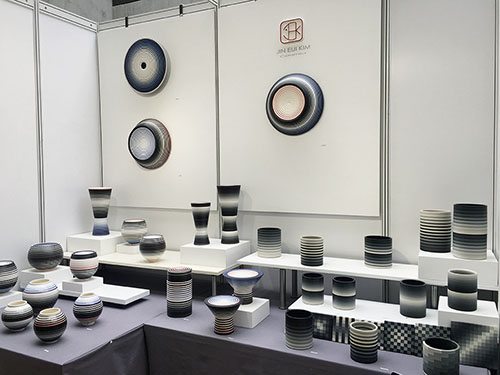
Ceramic Art London – Jin Eui Kim
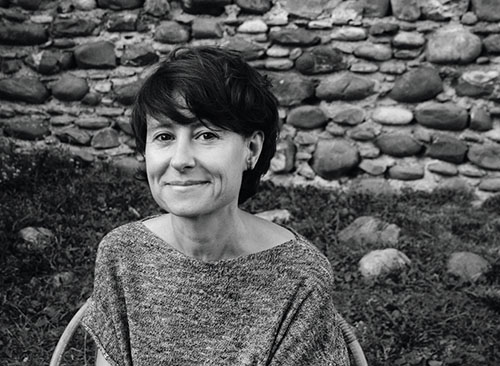
Sylvie Enjalbert
DATES
Dates and Exhibitions from Amsterdam to Winzer
[rs_section_title title=”Extracts” class=”p-b-30″]Profile: Si-Sook Kang – KR / D, John Dermer – AU, Gilles / Wiemann – FR, Arina Ailincai – RO
Exhibitions: Ceramic Art – London – GB, Fes_Tea_Val – Wiesbaden – DE, Delicate Wings – Fat Bluebottles – Frechen, DE
Artist-Journal: Rokubey Kiyomizu – JP and Sylvie Enjalbert – FR
In Studio: Ruth Ju-shih Li – Evelyne Schoenmann[/rs_section_title]
Exhibitions: Ceramic Art – London – GB, Fes_Tea_Val – Wiesbaden – DE, Delicate Wings – Fat Bluebottles – Frechen, DE
Artist-Journal: Rokubey Kiyomizu – JP and Sylvie Enjalbert – FR
In Studio: Ruth Ju-shih Li – Evelyne Schoenmann[/rs_section_title]
[rs_section_text_block heading=”Si-Sook Kang” btn_link_one=”url:%23||” btn_link_two=”url:%23||”]You came to Germany and stayed here – What was the reason for you to leave South Korea with its totally different ceramics culture, which is so highly esteemed by us “Westerners”?
The ceramics culture certainly differs depending on tradition and culture. But I find it extremely spontaneous and, at the same time, very diverse. Putting it differently, the various cultures differ in history, age and diversity, but our predecessors gave their best in their environment and the results are similar if we take the broad view.
The ceramics culture of Korea, China and Japan may be older and more diverse in comparison with other cultures but this is certainly dependent on the naturally available materials in East Asia. If we regard the history of ceramics, ceramics from Korea are certainly very interesting, of course. However, I was more interested in the present. I was interested in contemporary art and possible developments of the various materials. In contrast to when I was younger, I have recently begun to discover how I have increasingly immersed myself in the long history of Korean ceramics culture.
(Monika Gass)[/rs_section_text_block]
[rs_image_block image=”6059″ class=”p-t-30″]
Si-Sook Kang
[rs_promo_box style=”style7″ btn_text=”Order Now” link=”url:%23aboform||”]
Order easily on 02426-94 80 68 or by email on bestellungen@neue-keramik.de
[/rs_promo_box][rs_section_text_block heading=”John Dermer” btn_link_one=”url:%23||” btn_link_two=”url:%23||”]Our dialogue began in January 2017. During a visit to the Keramikmuseum Westerwald, the then director Monika Gass asked me to contact John Dermer, who had approached the Museum looking for advice. Although the name initially did not mean anything to me, I soon realised that he had to be a ceramic heavyweight. The last Saltfire Prize in 2006 awarded by the Chamber of Skilled Trades in Koblenz had gone to him. Not to the Westerwald, home of saltglaze, not to Europe but it had to go Down Under. When the opportunity presented itself to me to handle the Museum’s purchases of John Dermer’s works in its stores, I realised that this was saltglazed ceramics of the highest quality.
So who is John A. Dermer?
He was born in Melbourne, Australia, in 1949. Even during his early youth, he was always busy building things. Cardboard houses or building work in the neighbourhood aroused his interest. This certainly led to him building his own house later on. Eltham, an artists’ quarter in Melbourne, allowed him to plunge into the world of potters, sculptors and painters.
(Bodo Röder)[/rs_section_text_block]
[rs_image_block image=”6049″ class=”p-t-30″]
John Dermer
[rs_section_text_block heading=”Martine Gilles – Jaap Wieman” btn_link_one=”url:%23||” btn_link_two=”url:%23||”]As a young studio (established in 1975) we participated in 1985 in the first Biennale of Nevers earthenware, which included the great houses of earthenware with traditional know-how, in the Palais Ducal de Nevers, first castle of the Loire. To revive earthenware, participants created the Union Professionnelle de Maîtres Faïenciers de France, which we co-founded.
These large traditional factories were looking for young workshops knowing how to decorate. These no longer existed because under the influence of Bernard Leach, who synthesized Oriental and Western ceramics, art schools just taught how to work with stoneware. The art of the tea ceremony, with its bowls and its sober and rustic teapots, was very fashionable at that time.
At this moment every-thing is thrown on the wheel by Jaap Wieman, who models the fruits and the flowers adorning the pieces, which Martine Gilles then decorates with a brush of bright colours. The fine earthenware pieces are fired to a high temperature. Our unique and whimsical, imaginative and their individual expression draws recognition from our peers.[/rs_section_text_block]
These large traditional factories were looking for young workshops knowing how to decorate. These no longer existed because under the influence of Bernard Leach, who synthesized Oriental and Western ceramics, art schools just taught how to work with stoneware. The art of the tea ceremony, with its bowls and its sober and rustic teapots, was very fashionable at that time.
At this moment every-thing is thrown on the wheel by Jaap Wieman, who models the fruits and the flowers adorning the pieces, which Martine Gilles then decorates with a brush of bright colours. The fine earthenware pieces are fired to a high temperature. Our unique and whimsical, imaginative and their individual expression draws recognition from our peers.[/rs_section_text_block]
[rs_image_block image=”6051″ class=”p-t-30″]
Martine Gilles – Jaap Wieman
[rs_section_text_block heading=”Arina Ailincai” btn_link_one=”url:%23||” btn_link_two=”url:%23||”]The selection of works employs an approach consistently followed for some time, that of using sculptural-anthropomorphic metaphors to bring forth the eternally debated (fundamental problem of the relationship between the two dimensions of the human being): the world we perceive through our senses, the material world of the body – subject to erosion with time – and the inner world, where the “works” of the spirit and consciousness are deposited.
We tend to focus our attention and our gaze on the expressiveness of the body as exterior cover, in all its richness of manifested forms, while we also continually intuit that our inner archetypal world envelopes a fabulous universe, in which the spirit is tirelessly searching for ways to transcend the ephemeral nature of our existence. The relationship of coexistence between the interior and exterior is about our condition in this world and they function as complementary parts of the same whole. My wish is to create, metaphorically speaking, “tridimensional poems” and, to translate this message artistically, I chose as a formal vehicle the cast of the human body in different hypostasis.
Pressing the clay into plaster moulds it will form a body shape that represents ”the shell”, an empty vessel, which holds our inner self as well our personal and universal history. The scripts imprinted on the interior or exterior walls of the shell acquire symbolic and metaphoric dimensions, becoming a palimpsest which covers the entire human existence. [/rs_section_text_block]
We tend to focus our attention and our gaze on the expressiveness of the body as exterior cover, in all its richness of manifested forms, while we also continually intuit that our inner archetypal world envelopes a fabulous universe, in which the spirit is tirelessly searching for ways to transcend the ephemeral nature of our existence. The relationship of coexistence between the interior and exterior is about our condition in this world and they function as complementary parts of the same whole. My wish is to create, metaphorically speaking, “tridimensional poems” and, to translate this message artistically, I chose as a formal vehicle the cast of the human body in different hypostasis.
Pressing the clay into plaster moulds it will form a body shape that represents ”the shell”, an empty vessel, which holds our inner self as well our personal and universal history. The scripts imprinted on the interior or exterior walls of the shell acquire symbolic and metaphoric dimensions, becoming a palimpsest which covers the entire human existence. [/rs_section_text_block]
[rs_image_block image=”6048″ class=”p-t-30″]
Arina Ailincai
[rs_section_text_block heading=”CERAMIC ART LONDON – 22 – 24 March 2019 Central Saint Martins King’s Cross” btn_link_one=”url:%23||” btn_link_two=”url:%23||”]Central Saint Martins (CSM), well-known for lecturers and students of highest renown, offers a high-quality ceramically orientated course in art, design, research and history. As a part of the University of the Arts London (UAL), CSM is housed in an impressive complex in King’s Cross, Central Saint Martins. Students benefit from the comprehensive schooling system that provides traditional and digital units and workshops. Jointly used spaces, an extensive library and the central location speak for themselves. Famous ceramics graduates include Gordon Baldwin, Alison Britton, Rob Kesseler, Robin Levien, Richard Slee. www.arts.ac.uk/csm
In cooperation with the Craft Potters Association of Great Britain (CPA), which was founded in 1958, in March 2019 the 15th CAL took place with 90 artists – in most impressive surroundings. In 2019, ceramics fans came to look, to ask questions and to buy – at CAL, sales are permitted, even desired, and it is precisely this which determines the special character of the event for exhibitors and visitors. In addition, a range of fascinating talks took place – you can find an overview of subjects and content here: http://ceramicartlondon.com/claytalks
In cooperation with the Craft Potters Association of Great Britain (CPA), which was founded in 1958, in March 2019 the 15th CAL took place with 90 artists – in most impressive surroundings. In 2019, ceramics fans came to look, to ask questions and to buy – at CAL, sales are permitted, even desired, and it is precisely this which determines the special character of the event for exhibitors and visitors. In addition, a range of fascinating talks took place – you can find an overview of subjects and content here: http://ceramicartlondon.com/claytalks
(Monika Gass)[/rs_section_text_block]
[rs_image_block image=”6057″ class=”p-t-30″]
Jongjin Park
[rs_section_text_block heading=”“Delicate Wings, Fat Bluebottles – Insects and other Creatures in Ceramics“ – Exhibition at the KERAMION” btn_link_one=”url:%23||” btn_link_two=”url:%23||”]The study of certain animals was always considered ( and to a point still is) to be particularly glorious. If a scientist studied primates or big cats, or a big game hunter slew the famous “big five” in the plains of Africa, it earned them respect. In direct comparison to this, the collector of insects appears somewhat peculiar – as we can see in the painting, The Butterfly Catcher by Carl Spitzweg, the entomologist was imagined to be a pale, quirky loner. Yet currently entomologists are everywhere in demand as speakers – concern over the disappearance of many species of insects has reached large sections of the populace and more and more people are discussing the profound effects on our ecosystem. The exhibition, ZARTE FLÜGEL, DICKE BRUMMER – Insekten und sonstiges Getier in der Keramik (“DELICATE WINGS, FAT BLUEBOTTLES – Insects and other Creatures in Ceramics”) has taken the topicality of the subject as an occasion to study the highly complex relationship between humankind and insects with the aid of more than 200 pieces from four centuries by international artists from the UK, the Netherlands, Belgium, France, Italy, Germany and Turkey.
(Olga Moldaver)[/rs_section_text_block]
[rs_image_block image=”6050″ class=”p-t-30″]
Tirana coffee service, design Friedrich Fleischmann, 1927 photo: Regina Spitz
[rs_section_text_block heading=”FES_TEA_VAL – An exhibition of unique teapots large and small – NASPA WIESBADEN – until 16 August 2019″ btn_link_one=”url:%23||” btn_link_two=”url:%23||”]A bank goes together well with tea, considering the latter used to be literally worth its weight in gold. Tea: “the white gold of the emperor”, tea leaves and their preparation were once celebrated, so it is no wonder that creating teapots still inspires artists today. Chinese, Korean, Japanese tea is a cult drink that has long conquered our modern times. And the finest tea requires a culture of the finest vessels – unique, handmade in porcelain or stoneware and highly esteemed, they are simply part of tea drinking in Asia. But in our latitudes, enjoying beautifully made teapots is firmly established too. Whether it is enjoyed meditatively or as a healthy herbal beverage, tea seduces the senses. Tea only arrived in Europe – in the form of leaves or powder – in the early 17th century. In 1610, the Dutch East India Company imported the first green tea. This delicately scented herb soon found its way into house and home and is now a firm part of our culture. Delighted by the diversity of Asian teawares, the international ceramics world has devoted itself to the subject for over 100 years and created remarkable objects in every shape and size.
(Monika Gass)[/rs_section_text_block]
[rs_image_block image=”6061″ class=”p-t-30″]
Ah Leon
[rs_section_text_block heading=”Artist Journal: 8th ROKUBEY (MASAHIRO) Kiyomizu and Sylvie Enjalbert” btn_link_one=”url:%23||” btn_link_two=”url:%23||”]8th ROKUBEY (MASAHIRO) Kiyomizu (Japan)
KIYOMIZU was born in Kyoto, Japan in 1954. Firing clay in extreme heat inevitably causes collapse. This is the law of nature. How do we express the characteristics of clay based on our knowledge of the law? In Kiyomizu Rokubey VIII’s oeuvre, works of whatever size have no internal support; moreover, by carving lines or removing certain parts, or incising crosses and lines, he weakens their structure to accelerate the collapse caused by high-temperature firing.
Sylvie Enjalbert (France)
Sylvie Enjalbert was born in Rodez, France in 1973. The artist goes back in time to create a dialogue with the vessels made by ancestors. Not only that the forming process involves the interaction of Enjalbert’s body in dialogue with the medium, but the vessels have preserved the established traces of the artist’s fingerprints, and the simple, unadorned forms carry precision and sensibility.
(Ting-Ju SHAO )[/rs_section_text_block]
[rs_image_block image=”6054″][rs_image_block image=”6056″ class=”p-t-30″]
8th ROKUBEY (MASAHIRO) Kiyomizu
Sylvie Enjalbert
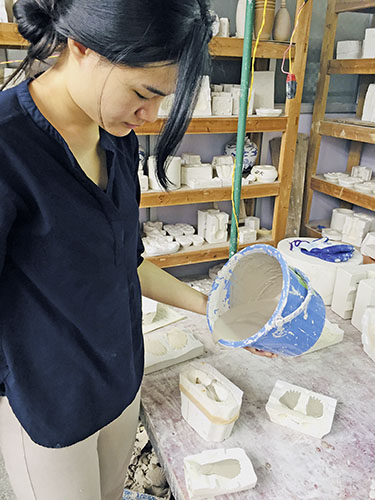
[rs_section_text_block heading=”In Studio with Ruth Ju-shih Li” btn_link_one=”url:%23||” btn_link_two=”url:%23||”]Ruth, we met in Yingge/Taiwan at the last IAC/AIC meeting and you told me about your very interesting background and busy life as an artist.
As an artist I divide my time between my studios in Sydney-Australia, Taipei (Taiwan) and in Jingdezhen (PR China). I was born in Taiwan and migrated to New Zealand with my family when I was three years old, and then to Australia when I was ten. Having lived most of my life in Sydney and studied at the National Art School in Australia, I identify as a Taiwanese-Australian artist.
As an artist I divide my time between my studios in Sydney-Australia, Taipei (Taiwan) and in Jingdezhen (PR China). I was born in Taiwan and migrated to New Zealand with my family when I was three years old, and then to Australia when I was ten. Having lived most of my life in Sydney and studied at the National Art School in Australia, I identify as a Taiwanese-Australian artist.
So you are at home in many countries, and you change studio and location quite often. At the moment, as you said, you alternate between Australia, PR China and Taiwan. Residencies are also an important part in your life. What is the reason you don’t want to settle down?
My work is heavily influenced by my diverse cultural heritage and the search for a common language. Research and observation play an enormous part in the growth of my work, so travelling and international residencies are a great source of fresh inspiration for me, constantly challenging and evolving my practice. My recent residency in Thailand was beautifully eye-opening.
(Evelyne Schoenmann)[/rs_section_text_block]
[rs_image_block image=”6053″ class=”p-t-30″]
Ruth Ju-shih Li
[rs_section_title style=”style2″ title=”Purchase a single issue here” class=”m-b-30″]Each issue is 10€ in Germany incl. 7% VAT, 11€ (EU), US$ 12€, 15sFr in Switzerland. Postage is calculated individually for single copies. (3,70€)[/rs_section_title]
[rs_contact_form form_id=”2847″]
[rs_space height=”15″]